

Cart
0
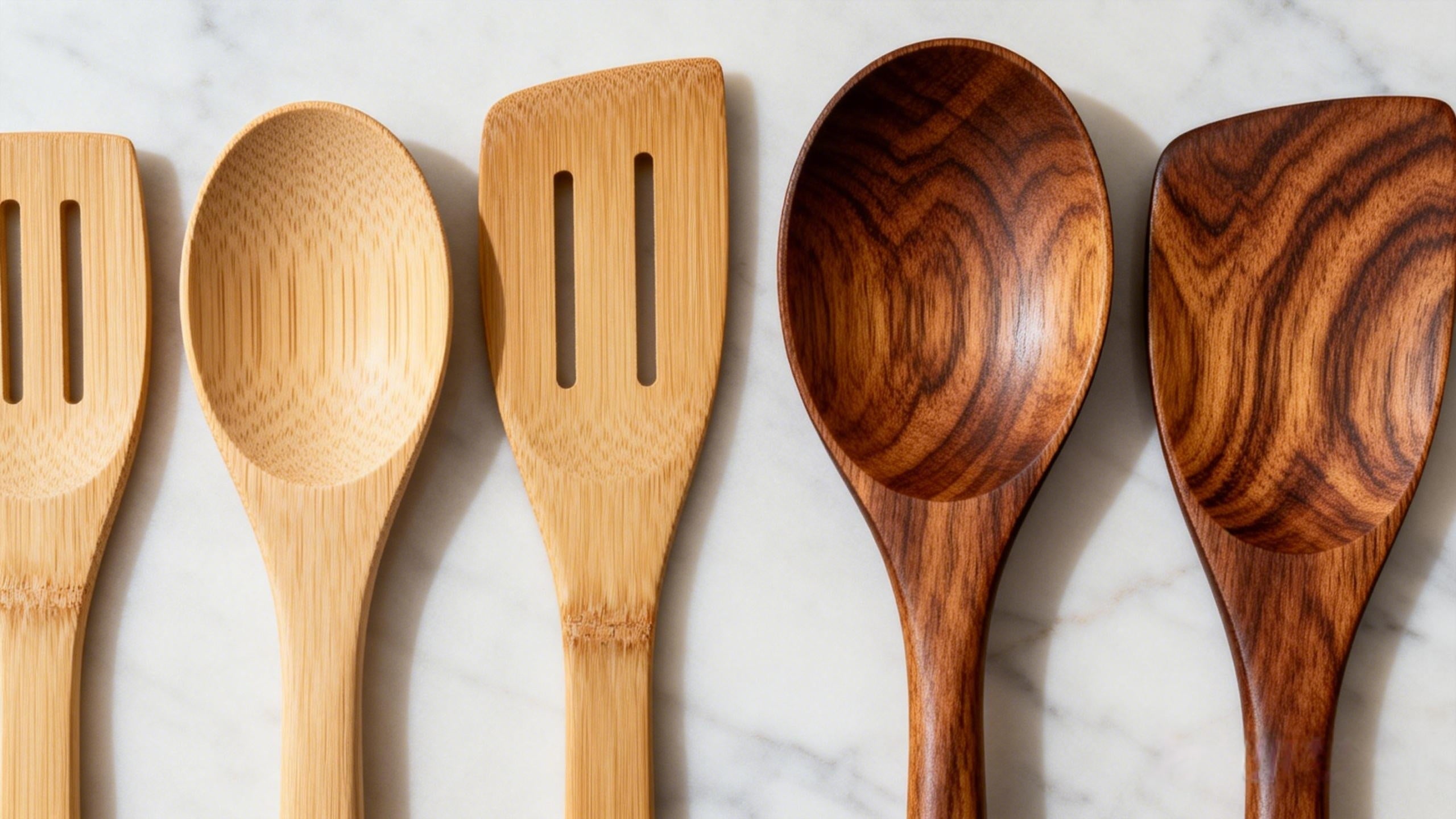
When choosing kitchen tools for everyday cooking, many home chefs face the same dilemma: bamboo vs. hardwood kitchen tools—what’s the actual difference, and which one is the superior investment?
Both bamboo and hardwood have surged in popularity as eco-friendly alternatives to melting plastics and scraping metals. They are natural, biodegradable, and gentle on expensive non-stick surfaces. However, beneath the surface, these two materials perform very differently. From cellular durability and food safety to maintenance rituals and long-term sustainability, here is everything you need to know to make an informed choice for your culinary space.
01 What Exactly Are Bamboo Kitchen Tools?
It is a common misconception that bamboo is a wood. Botanically, bamboo is a fast-growing grass. To turn a hollow, cylindrical stalk of grass into a flat spatula or a solid cutting board, it must undergo significant industrial processing.
How Bamboo Tools Are Made:
-
Slicing: The bamboo stalks are cut into thin strips.
-
Boiling: The strips are boiled to remove sugars and starch (which prevents insect infestation).
-
Lamination: Because bamboo isn't wide enough to be carved into a solid spoon, multiple strips are glued together under high pressure.
-
Shaping: The resulting laminated "board" is then CNC-machined into the final tool shape.
Key Characteristics: * Extremely lightweight.
-
Highly renewable (grows inches per day).
-
Budget-friendly price point.
-
Contains adhesives/glues by necessity.
02 What Are Hardwood Kitchen Tools?
Hardwood kitchen tools are crafted from the dense timber of slow-growing deciduous trees. Unlike the hollow stalks of bamboo, hardwoods like Acacia, Maple, Walnut, and Beech provide a solid, thick mass of fiber that can be worked directly by artisans.
The Craftsmanship of Hardwood:
High-quality hardwood tools are typically monolithic, meaning they are carved from a single, solid piece of timber. This eliminates the need for industrial glues and ensures the structural integrity of the tool remains consistent from the handle to the head.
Key Characteristics:
-
Naturally dense and heavy-duty.
-
Rich, varied grain patterns and deep textures.
-
Minimal industrial processing.
-
Incredible lifespan of 10–20+ years.

03 The Durability Showdown: Grass vs. Timber
The Brittle Nature of Bamboo
While bamboo is incredibly hard (harder than many woods), it is also quite brittle. Because it is a laminated product, its greatest weakness is its glue lines. Over hundreds of wash cycles, the heat and moisture cause the different strips of bamboo to expand and contract at different rates. This eventually leads to delamination—where the tool splits or cracks along the seams.
The Resilience of Hardwood
Hardwood tools are cohesive. Because they are not held together by glue, they handle the "thermal shock" of a hot kitchen much better. Hardwoods like Maple and Acacia have tight grains that naturally resist water penetration. If a hardwood tool becomes rough after years of use, it can be sanded down and re-oiled, essentially "resetting" its lifespan. Bamboo cannot be sanded in the same way without risking the integrity of its laminated layers.
👉 Durability Winner: Hardwood Kitchen Tools
04 Safety & Food Contact: The Hidden Chemicals
Bamboo and Adhesives
Since bamboo tools are a "composite" product, you must consider what is holding them together. Many mass-produced bamboo utensils use formaldehyde-based glues or other synthetic resins. As the tool wears down or is exposed to high heat in a boiling soup, these adhesives can potentially leach into your food.
The Purity of Hardwood
A single-piece hardwood spoon requires no glue. It is a pure, biological material finished with nothing but food-grade mineral oil or beeswax. Furthermore, hardwoods like Maple have been scientifically proven to have capillary action that traps and kills bacteria within the wood fibers, making them one of the most hygienic surfaces for food preparation.
👉 Food Safety Winner: Hardwood Kitchen Tools

05 Maintenance & The "Aging" Factor
The "Dry Out" Problem
Bamboo has a very high silica content, which makes it feel "woody" but also prone to feeling dry and splintery quite quickly. It doesn't absorb maintenance oils as deeply as hardwood does, meaning it loses its luster and becomes "fuzzy" or "hairy" after just a few months of heavy use.
Aging Like Fine Wine
Hardwood tools are like cast iron skillets—they get better with age. As you oil a walnut or acacia spoon, the wood develops a deep, rich patina. The fibers remain supple and smooth. A hardwood tool that has been used for five years will often feel more comfortable in the hand than a brand-new one.
06 Sustainability: The Full Picture
The Case for Bamboo: It grows exceptionally fast and requires few pesticides. If you are looking for a tool that can be replaced every year with minimal environmental guilt, bamboo is a strong contender.
The Case for Hardwood: While trees grow slower, the longevity of the tool is the ultimate sustainability factor. Replacing five bamboo sets over ten years creates more industrial waste and shipping emissions than buying one high-quality hardwood set that lasts the entire decade. When sourced from FSC-certified forests, hardwood is a carbon-sequestering powerhouse.

07 Comparison Table: At a Glance
Bamboo vs Hardwood Kitchen Tools: Comparison Table
| Feature | Bamboo Tools | Hardwood Tools |
|---|---|---|
| Durability | ⚠️ Medium | ✅ High |
| Food Safety | ⚠️ Depends on glue | ✅ Naturally safe |
| Heat Resistance | ❌ Lower | ✅ Higher |
| Maintenance | ⚠️ Moderate | ✅ Easy |
| Lifespan | 2–5 years | 10–20 years |
| Aesthetic | Simple | Rich & natural |

Final Verdict: Which One Truly Belongs in Your Kitchen?
If you are a student moving into a temporary dorm or need a lightweight set for a camping trip, bamboo is a functional, low-cost choice.
However, for the intentional home cook who values food safety, tactile comfort, and environmental responsibility, hardwood kitchen tools are the clear winner. They provide a superior sensory experience, they are safer for your family, and they represent a timeless investment in your home.
At Oakory, we believe in the "Buy Once, Buy Well" philosophy. Our hardwood collection is designed to be the last set of utensils you’ll ever need to buy.
👉 [Explore the Oakory Hardwood Utensil Collection] 👉 [Shop Artisan Acacia Cutting Boards]

